The Multan Dealer Boom: How the City Got 5,000 New Property Offices in Six Years — and What It Broke
By Zamai Property Partners · May 2026 · 6 min read
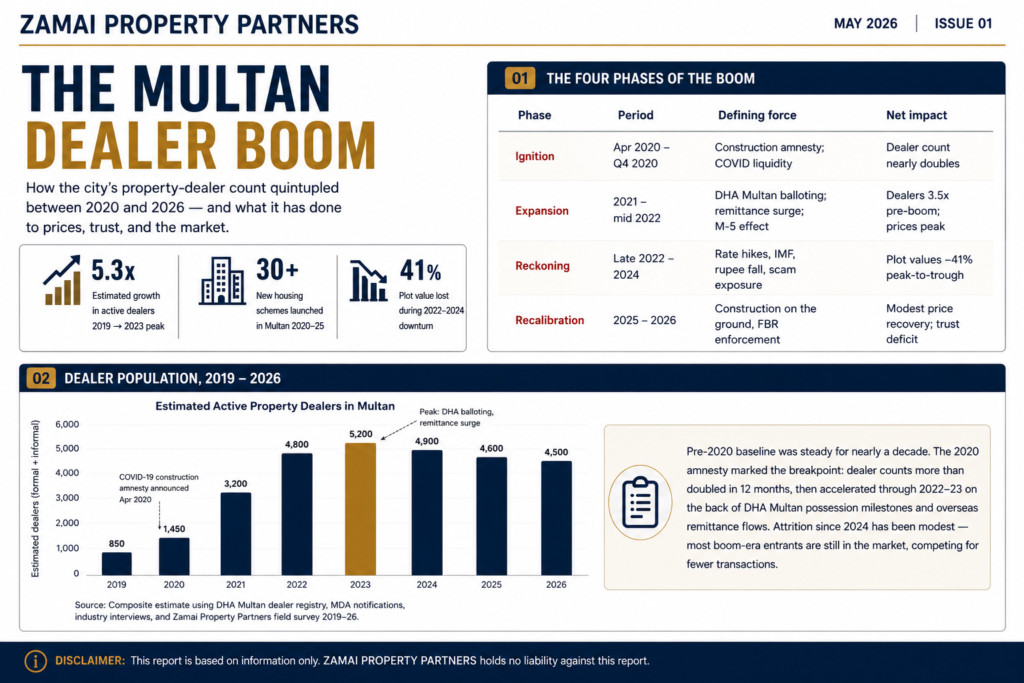
Between 2020 and 2026, something unusual happened in Multan’s real estate market. If you spent any time on Bosan Road, Northern Bypass, or around the expanding commercial strips near DHA Multan, you would have noticed it almost immediately. Property offices seemed to appear overnight. What was once a business dominated by a relatively small circle of established agencies suddenly became crowded with consultants, brokers, freelancers, social media agents, and self-styled real estate advisors. In just a few years, property dealing in Multan shifted from a specialised profession into something that almost anyone seemed willing to try.
A decade ago, the local property market felt much smaller and far more predictable. Buyers generally knew the names of serious agencies, and most transactions happened through offices with established reputations. Many firms had been operating for years, sometimes generations, and trust played a major role in how business was conducted. That landscape has changed dramatically. Today, a polished office is no longer the standard marker of credibility. Some dealers operate from commercial plazas, others from shared desks, and some have no physical office at all, relying entirely on WhatsApp, Facebook, or YouTube to attract clients.
The turning point was 2020. COVID disrupted traditional businesses and pushed many people to look for alternative income sources. At the same time, Pakistan’s construction sector incentives created renewed excitement around real estate investment. Multan happened to be well positioned for that wave. DHA Multan was beginning to show real development progress, the M-5 Motorway improved connectivity, overseas remittances remained strong, and multiple housing schemes were launching aggressively. For many people, real estate looked like the easiest opportunity available, and property dealing became the preferred entry point.
What followed was not gradual growth but a rapid explosion. People who had never worked in real estate began facilitating small deals, earning commissions, and deciding to stay in the business. Informal brokers emerged everywhere—friends connecting buyers to sellers, part-time consultants chasing leads, and newcomers trying to build credibility through social media. The barriers to entry were almost non-existent. A smartphone, confidence, and a few property videos were often enough to start appearing legitimate.
Social media accelerated the transformation. Before this period, property sales in Multan were largely relationship-based, with trust built through personal connections and local reputation. After 2020, visibility became the new currency. Younger dealers embraced YouTube walkthroughs, TikTok clips, drone footage, and Facebook marketing far faster than traditional firms. Suddenly, a person sitting in Multan could generate inquiries from Karachi, Lahore, Dubai, Toronto, or Birmingham without ever meeting a client face to face. In many cases, digital presence began to replace professional credentials in the minds of buyers.
To be fair, not all of this change was negative. The newer generation brought energy and modern marketing practices to a market that had often felt outdated. Presentation standards improved. Response times became faster. Multan’s property sector gained wider visibility, especially among overseas Pakistanis. But the same accessibility that encouraged innovation also lowered standards. When anyone can enter a profession overnight without training, licensing, or accountability, the quality of market participants inevitably becomes inconsistent.
By late 2021 and into 2022, the market felt unstoppable. Plot prices were rising, investors were flipping files quickly, and new housing projects kept entering the conversation. Confidence was high, perhaps unrealistically so. In such an environment, people stop asking whether prices are sustainable and start assuming growth will continue indefinitely. That mindset fed the dealer boom, because when everyone believes transactions will keep happening, everyone wants a share of the commissions.
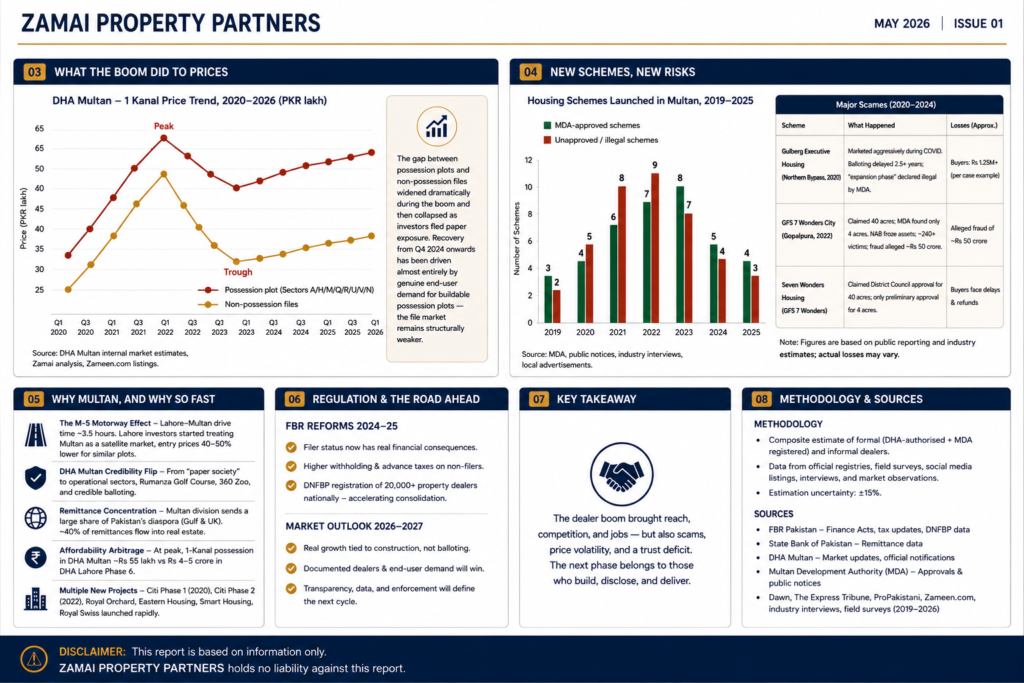
The correction, when it came, was harsh. Rising interest rates, inflation, higher construction costs, tax pressures, and weakening speculative confidence slowed the market significantly. The easy-money phase ended, and the difference between genuine businesses and temporary operators became obvious. Established firms survived because they had systems, repeat clients, and reputations to protect. Informal operators often vanished just as quickly as they had appeared. Buyers who had trusted branding or aggressive sales pitches discovered that some “agencies” were little more than short-term setups.
Perhaps the biggest damage was not purely financial, but reputational. Trust in the profession took a major hit. When buyers repeatedly encounter exaggerated claims, manipulated pricing, unclear approvals, or disappearing agents, they become sceptical of everyone—including honest professionals. That trust deficit still affects the market today. Serious agencies continue to operate responsibly, but suspicion has become a natural starting point for many buyers.
The rapid expansion of loosely regulated selling also created opportunities for poor-quality or questionable projects to gain traction. Buyers often assumed that if multiple dealers were promoting a scheme, it must be credible. That assumption proved costly in many cases. Approval status, possession claims, and development timelines became areas where buyers needed far more caution than many initially realised.
By 2026, the market feels more grounded. It is no longer driven by the same speculative enthusiasm, but it is not collapsing either. Real development activity in stronger projects has helped restore some confidence. DHA Multan’s possession sectors show actual residential construction, educational institutions are contributing to end-user demand, and investors appear more selective than they were during the peak years. That is a healthier environment overall.
Still, the dealer overhang remains. Many individuals who entered the market during the boom are still active, competing for fewer transactions in a more cautious environment. That pressure can encourage shortcuts, aggressive selling, or misleading positioning. Buyers today need to be far more deliberate than those who entered during the hype cycle.
The Multan dealer boom left behind a mixed legacy. It modernised marketing, created employment, expanded visibility, and brought fresh energy into the city’s real estate sector. But it also increased noise, weakened trust, and made it harder for ordinary buyers to distinguish between professionals and opportunists. Both realities exist at the same time.
The most practical lesson for buyers remains simple: verify the person, not just the project. A professional-looking social media page is not proof of credibility. Ask questions, visit offices, cross-check approvals, compare rates, and be cautious of urgency-driven sales tactics. In today’s market, patience is often more valuable than speed.
At Zamai Property Partners, we believe real estate should be transparent, documented, and professionally handled. Whether you are buying, selling, or simply trying to understand where the market stands, informed decisions matter more than ever.