Pakistan Economic Outlook 2026: Growth, Infrastructure Investment and Development Opportunities
Pakistan 2026: Stabilization, Development Spending, and CPEC 2.0
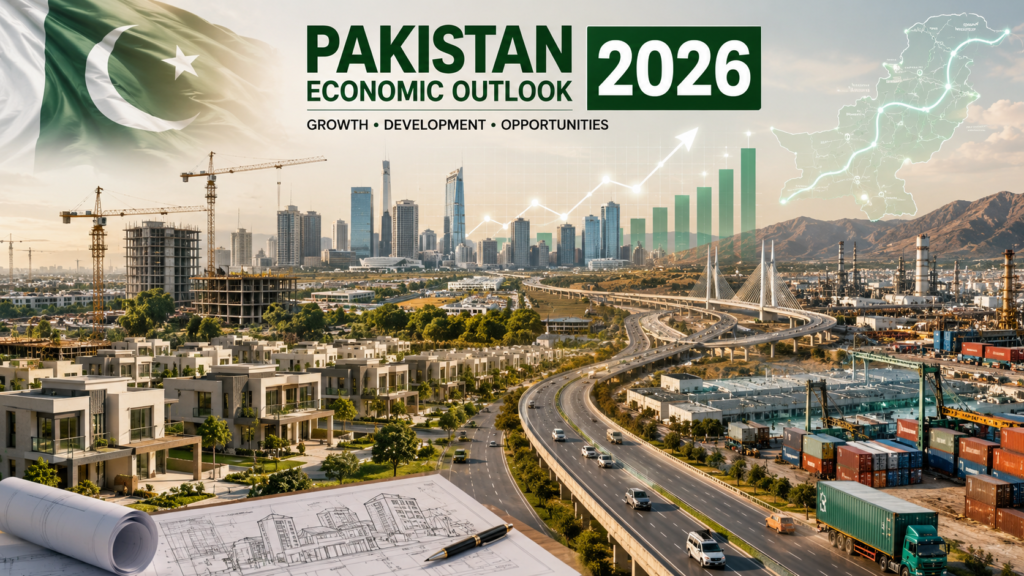
Key Takeaways
- Pakistan’s provisional GDP growth for FY 2026 is reported at 3.70%, with services contributing most strongly among sectors.
- Sectoral contributions to provisional growth indicate services at 4.09%, industry at 3.51%, and agriculture at 2.89%.
- The federal government has prioritised development spending, allocating approximately Rs 3.6 trillion for development projects in FY 2026‑27 and proposing development programmes in excess of Rs 4.4 trillion.
- CPEC 2.0 remains a central policy pillar, with emphasis on infrastructure and industrial cooperation.
- Policy messaging in 2026 highlights macroeconomic stabilisation, easing inflationary pressures, and strengthening fiscal outcomes as foundations for recovery.
Quick Facts Table
| Indicator | Reported Value / Focus |
| Provisional GDP Growth (FY 2026) | 3.70% |
| Services Sector Contribution | 4.09% |
| Industry Sector Contribution | 3.51% |
| Agriculture Sector Contribution | 2.89% |
| Development Budget Allocation (FY 2026‑27) | Rs 3.6 trillion |
| Proposed Development Programmes | Over Rs 4.4 trillion (subject to review) |
| Strategic Initiative | CPEC 2.0 — infrastructure and industrial cooperation |
Introduction
This article summarises available, verified information on Pakistan’s economic and development landscape as reported for early 2026. The government and official publications indicate a phase of cautious stabilisation, underpinned by easing inflationary pressures, improving industrial activity, and stronger fiscal outcomes. Large development allocations and renewed emphasis on infrastructure—particularly under CPEC 2.0—feature prominently in recent federal planning. The purpose of this review is to synthesise the reported facts and draw out pragmatic implications for policy watchers, businesses, and property stakeholders.
Why It Matters
Macro stability and targeted public investment are foundational to medium‑term economic performance. The reported provisional GDP growth and sectoral contributions provide a snapshot of where activity is concentrated. Simultaneously, the large development budget and multi‑trillion‑rupee programme proposals indicate a pivot towards capital spending that could shape infrastructure, urban planning, and industrial capacity. For planners, investors, and local businesses, understanding these priorities helps align expectations, identify potential demand drivers, and highlight where verification and closer due diligence will be required.
Recent Developments
- Official reporting for FY 2025‑26 shows consolidation of macroeconomic stability and improved fiscal balances.
- The Pakistan Economic Survey 2025‑26 was released and presents the provisional growth breakdown and sectoral performance cited above.
- Federal budget announcements for 2026‑27 placed a notable emphasis on development expenditure, with Rs 3.6 trillion earmarked for development projects.
- CPEC 2.0 initiatives continue, with renewed focus on infrastructure connectivity and industrial cooperation in planning documents.
- The National Economic Council was scheduled to review proposed development programmes exceeding Rs 4.4 trillion, reflecting large‑scale planning intent.
Investment Snapshot
Available information suggests a policy environment that is increasingly oriented toward infrastructure, transport links, and industrial support. Key themes that emerge from the reported developments are:
- Transport and urban infrastructure as priority allocation areas.
- Public investment in health, education, and physical planning integrated with development projects.
- CPEC 2.0 as a continued framework for cross‑border infrastructure and industrial cooperation.
These priorities may generate business opportunities in construction, logistics, urban services, and sectors that support industrial clusters. However, exact project timelines, geographic distribution, and specific scheme details require further verification from official project documents and implementing agencies.
Market Analysis
The provisional sectoral performance indicates a services‑led recovery by reported figures, with industry and agriculture also contributing positively. Notable points include:
- Services (4.09% reported) remain the largest contributor to growth, suggesting continued resilience in trade, transport, finance, and related services.
- Industry growth (3.51% reported) signals improving manufacturing and mining activities, which can be sensitive to both domestic demand and external trade conditions.
- Agriculture growth (2.89% reported) contributes to overall stability but can be subject to seasonality, input costs, and climatic factors.
- Restoration of macroeconomic stability and improved fiscal outcomes are reported as improving the overall investment climate, though investor confidence will depend on policy continuity and project implementation clarity.
Comparison Table
| Area | Reported Emphasis / Outcome |
| Macro Stability | Easing inflation and improved fiscal balances reported |
| Services Sector | Largest contributor to growth (4.09% provisional) |
| Industry Sector | Recovery signalled (3.51% provisional) |
| Agriculture Sector | Positive contribution (2.89% provisional) |
| Public Investment | Rs 3.6 trillion allocated for development; proposals over Rs 4.4 trillion under review |
| CPEC 2.0 | Ongoing focus on connectivity and industrial cooperation |
Investment Score
The Investment Score is qualitative. Based on reported stabilisation trends, sectoral performance, and heightened development spending, the environment may be described as cautiously improving. Public‑sector emphasis on transport, urban infrastructure, and industrial cooperation suggests selective opportunities, subject to verification of project details and implementation schedules.
Investment Insight
For investors and businesses considering exposure to Pakistan’s development agenda, a few pragmatic considerations arise from the verified information:
- Prioritise due diligence on project-specific documentation, procurement timelines, and financing arrangements before committing capital.
- Seek clarity from official sources on geographic focus and phasing of the Rs 3.6 trillion development envelope and the proposed Rs 4.4 trillion programmes.
- Consider sectors linked to infrastructure delivery—construction, materials, logistics, and services supporting industrial zones—as areas where policy attention is concentrated.
- Monitor CPEC 2.0 announcements for industrial cooperation opportunities, while recognising that detailed project-level disclosures may lag aggregate policy statements.
Buyer Checklist
- Verify project approvals, funding arrangements, and implementing agency contacts with official government releases.
- Confirm timelines and physical scope of any infrastructure scheme before entering contracts or making land-related decisions.
- Engage technical and legal advisors for site inspections, permits, and regulatory compliance checks where relevant.
- Assess currency and macro risks, and consider contractual protections where projects involve longer time horizons.
- Track Pakistan Economic Survey 2025‑26 and subsequent government briefings for updates on sectoral performance and spending allocations.
Pros and Cons
- Pros: Reported macro stabilisation, clearer development priorities, large public investment envelope, continued CPEC framework.
- Cons: Project‑level timelines and geographic distribution remain insufficiently disclosed in public summaries; implementation risks and the need for on‑ground verification remain material considerations.
Market Outlook
According to available updates, Pakistan’s near‑term market outlook is shaped by cautious stabilisation and an active public investment programme. If implementation follows through, transport and urban infrastructure spending alongside industrial cooperation could support broader economic activity. Nonetheless, outcomes will depend on detailed project rollouts, financing, and institutional capacity. Continued monitoring of official sources and on‑ground developments will be important for market participants.
FAQ
Q: What is the headline GDP number for FY 2026?
A: The provisional GDP growth reported for FY 2026 is 3.70%.
Q: Which sectors contributed most to the reported growth?
A: Reported provisional contributions are services at 4.09%, industry at 3.51%, and agriculture at 2.89%.
Q: How large is the development budget for 2026‑27?
A: The federal budget reported an allocation of Rs 3.6 trillion for development projects in FY 2026‑27, with proposed programmes exceeding Rs 4.4 trillion under review.
Q: What role does CPEC play in the 2026 outlook?
A: CPEC 2.0 is described as a continuing strategic driver, with emphasis on infrastructure connectivity and industrial cooperation in recent planning documents.
Q: Are detailed project timelines and locations available?
A: The research summary notes that specific project timelines and geographic distribution require further verification from implementing agencies and official project documents.
Sources and Recent Developments Referenced
The analysis above is based on verified summaries drawn from official government publications and public policy documents, including:
- Pakistan Economic Survey 2025‑26 (official reporting of provisional growth and sectoral performance)
- Federal budget announcements for FY 2026‑27 (development allocation of Rs 3.6 trillion)
- Planning Commission development programme proposals and National Economic Council review notices (proposed programmes exceeding Rs 4.4 trillion)
- Public statements and policy outlines regarding CPEC 2.0 and infrastructure focus
Disclaimer
This article is for general information and market awareness only. It should not be treated as legal, financial, tax, or investment advice. Property prices, approvals, possession status, development progress, society policies, and market conditions may change over time. Readers should verify all information from official society sources, government authorities, legal advisors, and on-ground inspection before making any property decision. Zamai Property Partners does not accept liability for decisions made solely on the basis of this article.
Bottom Line
Early 2026 reporting indicates a cautiously stabilising Pakistani economy supported by easing inflation, improving industrial activity, and stronger fiscal outcomes. The federal government’s notable shift toward development spending—highlighted by a Rs 3.6 trillion allocation and multi‑trillion‑rupee programme proposals—places infrastructure, transport, and industrial cooperation (including CPEC 2.0) at the centre of the policy agenda. These developments suggest selective opportunities for businesses and investors that align with public spending priorities, though detailed project verification and careful due diligence are essential.
Conclusion
Pakistan’s 2026 economic narrative, as reflected in official summaries, is one of cautious recovery and reorientation toward public investment in infrastructure and industrial capacity. Market participants should interpret the available data as a directional signal rather than definitive project‑level guidance. Close monitoring of implementing agencies, budget execution reports, and on‑ground project updates will be necessary to translate these macro‑level priorities into actionable opportunities.
Zamai Property Partners Insight
Zamai Property Partners views the reported stabilisation and development focus as important context for stakeholders assessing opportunities in construction, logistics, and urban services. We recommend that clients and partners prioritise verification of project details, engage with local advisors, and maintain a medium‑term perspective when evaluating exposure to public infrastructure programmes and CPEC 2.0 initiatives.