Pakistan Real Estate Investment Guide 2026

MyZameen Property Blocks in Pakistan: Returns, Risks, Lock-In Periods and the Halal or Haram Question

A detailed, neutral and source-backed guide for small investors considering fractional property investment from PKR 10,000.

Important editorial position: This article does not issue a personal fatwa. It explains the publicly advertised MyZameen model and compares it with recognized Islamic-finance principles. As of 11 July 2026, we did not find a publicly accessible fatwa from a recognized Shariah board or leading mufti that specifically certifies MyZameen Property Blocks as Halal or declares them Haram.

MyZameen Property Blocks is one such model. The platform presents selected properties as smaller participation units known as Property Blocks, allowing users to start from PKR 10,000. The attraction is easy to understand: a person who cannot buy a full apartment may still gain exposure to rental income and possible price appreciation by purchasing a small share linked to that property.

What is MyZameen?

MyZameen is presented as a fractional real estate platform powered by Zameen.com. Its public website states that users can begin with PKR 10,000, access premium real estate, receive rental income and potentially benefit from capital gains. The platform’s homepage currently advertises up to 8% annual rental yield, while also stating that returns may vary with market conditions.[1]

Zameen’s promotional articles describe a Property Block as participation in a property’s economic performance. According to those materials, a block may be connected with rental income or cashback and potential long-term appreciation.[2] Another Zameen article says some arrangements offer rental yield or cashback of up to 12%. These are advertised or projected figures, not independently verified guarantees.[3]

The language used matters. Economic participation may not always be identical to direct registered title in the investor’s own name. Before investing, the customer should obtain the actual investor agreement and confirm whether the legal structure provides beneficial ownership, contractual rights, trust-based ownership, company shares, units in a special-purpose vehicle or some other arrangement.

How Property Blocks appear to work

A high-value property can be broken into smaller monetary units. Imagine a completed apartment worth PKR 20 million. If each block is priced at PKR 10,000, the asset’s value could theoretically be represented by 2,000 blocks. An investor buying ten blocks would commit PKR 100,000 and would expect returns proportionate to the rights attached to those blocks.

Entry amountPublic material states that participation starts from PKR 10,000 per block.
Income sourceRental distributions or cashback may be linked to the underlying property.
Growth sourceThe block value may rise if the property appreciates and is later sold at a higher price.

The MyZameen FAQ says an investor can purchase one or more blocks, subject to a stated limit of up to 40% of a property’s value in a preferred listing. It also says that, after the commitment period, block owners vote on whether to sell the asset or continue holding it.[4]

This voting mechanism is important because exit may not be as immediate as withdrawing funds from a bank account or selling a liquid stock. The investor may have to wait until the minimum holding period ends and may then depend on the applicable voting process, sale conditions and availability of buyers.

Where can the return come from?

1. Rental income or cashback

For completed and rented properties, the most understandable source of return is rent. If the property earns net rental income, investors may receive a proportionate distribution after deductions permitted by the agreement. Depending on the contract, those deductions could include maintenance, taxes, vacancy costs, property management, insurance, service charges or platform fees.

The MyZameen homepage currently displays up to 8% annual rental yield, subject to market conditions.[1] The official FAQ also describes built-property rental yield as a projected estimate that may vary by project and describes developmental-property cashback as a projected estimate.[4]

2. Capital appreciation

Capital appreciation occurs if the underlying property becomes more valuable. Suppose an investor purchases PKR 100,000 of blocks and the net realizable value of the corresponding interest later rises by 20%. Before taxes and fees, the investment may be valued at approximately PKR 120,000. If the property falls in value, the opposite can happen.

Illustrative return comparison

6.33% example claim
6.33%
Up to 8% homepage/FAQ
8%
Up to 12% article/FAQ claim
12%

These are platform-published examples or maximum claims from different pages, not a promise that every property will deliver the same return.

Is the money fixed for one, two, three or four years?

The answer depends on the type of property. The MyZameen FAQ states a minimum holding period of one year for built properties and four years for developmental properties.[4] Zameen’s February 2026 explainer also describes a one-year minimum lock-in for the general Property Block structure.[2]

This does not necessarily mean that an investor can freely choose any term from one to four years for every listing. Instead, the minimum commitment appears to be linked to whether the asset is completed or under development. A completed, income-producing unit may have a shorter minimum period, while a development-stage asset may require a longer commitment because construction and appreciation take time.

Do not rely only on a salesperson’s verbal explanation. The legally binding commitment period, early-exit rules, voting threshold, valuation method and transfer charges should be clearly stated in the signed agreement for the specific property.

Possible benefits for small investors

Lower barrier to entry

The main benefit is affordability. PKR 10,000 is significantly lower than the amount normally required to buy a plot, apartment or commercial unit. This allows younger investors, salaried individuals and people building savings gradually to participate in property-related investment.

Diversification

An investor with PKR 500,000 could theoretically spread the amount across different properties instead of concentrating everything in one asset. Diversification may reduce the effect of one property remaining vacant or underperforming, although it cannot eliminate market risk.

Professional management

The platform model aims to remove everyday tasks such as finding tenants, collecting rent, maintaining the unit and handling operational matters. This may be useful for overseas Pakistanis or investors who do not want to manage property directly.

Exposure to rental assets

Traditional small plot investment usually produces no regular cash flow. A share in a rented apartment or commercial property may generate periodic income, provided the rent is actually collected and the contract passes it to block holders after applicable deductions.

Digital access and reporting

A digital platform can make account statements, block ownership records, property details and distributions easier to view. Still, a digital dashboard is not a substitute for legally enforceable ownership and transparent financial reporting.

The main risks investors must understand

  • Capital loss: property prices may decline, and an investor may receive less than the original amount upon sale.
  • Liquidity risk: there may be no immediate buyer for the blocks or the underlying property.
  • Valuation risk: the asset may be offered at a price higher than its realistic market value.
  • Vacancy risk: an empty unit may produce little or no rent while expenses continue.
  • Development risk: under-construction properties may face delay, cost escalation, approval issues or non-completion.
  • Platform risk: investors depend on the operator’s recordkeeping, governance, collection and distribution systems.
  • Contract risk: marketing language may sound stronger than the legal rights in the investor agreement.
  • Fee risk: management, transfer, maintenance, tax and exit charges may reduce the headline return.
  • Concentration risk: buying blocks in only one project still leaves the investor exposed to that project.
  • Regulatory risk: fractional property structures may be treated as securities or collective investments depending on their legal form.

What does the SECP context mean?

In December 2021, the Securities and Exchange Commission of Pakistan issued a public warning concerning named companies that were selling unauthorized fractional interests in real assets. The notice stated that the listed platforms did not have approval to perform that function under the SECP regulatory sandbox and reminded the public that securities cannot be sold without the required approval.[5]

That warning did not name MyZameen, which appears to have launched its current Property Blocks offering later. Therefore, it would be inaccurate to use the 2021 warning as proof that MyZameen is illegal. It is nevertheless highly relevant because it demonstrates that company registration alone is not sufficient. An investor must verify the specific regulatory basis on which a fractional real estate product is offered.

Before investing, request documentary answers to the following questions: Which legal entity receives the money? Which entity holds title to the property? Is the offering approved, registered, exempt or operating within a recognized framework? Are the blocks treated as securities, contractual participation rights, beneficial interests or company shares? Who audits the arrangement? Where are investor funds held before completion?

MyZameen compared with other investment options

FactorMyZameen Property BlocksDirect plotRental apartmentBank deposit
Starting capitalLow, advertised from PKR 10,000Usually highHighCan be low
Regular incomePossible on income-producing propertiesNormally noneYes, if rentedYes, according to account terms
Management burdenMostly platform managedLow after purchaseModerate to highVery low
LiquidityDepends on commitment and exit processOften slowOften slowUsually higher, subject to terms
ControlLimitedHighHighNot applicable
Capital guaranteeShould not be assumedNoNoDepends on product and law
Shariah questionDepends on legal structure and contractsGenerally asset ownership, subject to financing and useGenerally asset ownership, subject to financing and useConventional interest accounts raise riba concerns

Property Blocks may be more accessible than direct ownership, but they also provide less control. A direct owner can decide when to sell, whom to rent to and how to renovate. A fractional investor generally relies on the platform and collective decision-making. Neither model is automatically superior; the correct choice depends on capital, time horizon, legal comfort, income goals and risk tolerance.

Islamic-finance analysis: when can fractional property ownership be Halal?

Islamic law recognizes shared ownership and partnership. Multiple people may jointly own a lawful asset and divide its income according to their ownership or an agreed, valid partnership arrangement. Therefore, fractional real estate is not automatically Haram merely because the asset is divided into smaller interests.

The Accounting and Auditing Organization for Islamic Financial Institutions publishes Shariah Standard No. 12 on Sharikah or Musharakah and modern corporations.[6] This is a recognized institutional reference, although it is not a fatwa specifically about MyZameen.

Conditions that support permissibility

Genuine ownership: The investor should own a real, identifiable share or legally recognized beneficial interest in a lawful property, rather than merely lending money to the platform.

Income connected to the asset: Rental income should come from actual use of the property. It should not be a predetermined interest payment on cash.

Risk of ownership: Entitlement to profit is connected to bearing ownership risk. If the property loses value, remains vacant or incurs legitimate costs, investors may be affected according to the contract.

Clear contracts: The property, purchase price, rights, fees, distribution formula, management authority and exit mechanism should be sufficiently clear to avoid excessive uncertainty.

Lawful use: The property should not be knowingly leased for activities prohibited under Shariah.

No guaranteed profit masquerading as rent: A forecast or target is different from an unconditional promise to pay a fixed return regardless of actual rental performance.

Conditions that may create Shariah problems

A fractional model can become problematic if the investor does not truly own or bear risk in the asset, while the platform guarantees repayment of capital plus a fixed profit. In a genuine Musharakah, the partnership should not be transformed into a risk-free loan for one party.

Another issue is the sale of an investment interest before the underlying asset exists or before the pool mainly represents tangible assets. Development-stage projects can involve cash, receivables, construction obligations and future assets. The Shariah rules for trading such interests may be more complex than those for a completed and rented property.

There can also be concern if cashback is guaranteed by the developer rather than generated from actual rent. Cashback is not automatically Haram, but its legal and economic source must be examined. Is it a price discount, a marketing incentive, a payment from the developer’s funds, or genuine income produced by the property? The answer can affect the Shariah analysis.

So, is MyZameen Halal or Haram?

Evidence-based conclusion: MyZameen cannot responsibly be declared definitively Halal or definitively Haram solely from its public marketing pages. The model appears capable of being structured in a Shariah-compliant way because it is linked to real property, rental income and capital appreciation. However, a final ruling requires review of the actual investor agreement, title-holding structure, risk allocation, guarantees, fees, development-stage arrangements and exit terms.

MyZameen’s homepage itself displays the words “Halal Income.”[1] That is a claim by the platform, not an independent fatwa. At the time of this review, we did not locate a publicly accessible Shariah certificate naming the scholars, scope, date, conditions and specific contracts reviewed for the Property Blocks product.

Accordingly, this article does not claim that recognized ulema have certified MyZameen, because no specific public fatwa was found. It also does not label the product Haram without contractual evidence of riba, invalid guarantees or another prohibited element. The honest position is conditional: fractional ownership can be Halal in principle, but the Shariah status of this particular platform depends on its documents and implementation.

A Muslim investor who needs religious certainty should obtain the investor agreement and submit it to a qualified mufti experienced in Islamic commercial law and modern finance. The mufti should be asked to review the complete arrangement, not merely a screenshot showing an advertised yield.

Due-diligence checklist before investing

  1. Ask for the complete investor agreement before making payment.
  2. Confirm the exact legal entity receiving your money.
  3. Obtain documentary proof of title and identify the registered owner.
  4. Ask whether you receive registered title, beneficial ownership, company shares or contractual participation rights.
  5. Verify the property’s approvals, completion status and encumbrances.
  6. Request the independent valuation and the date on which it was prepared.
  7. Ask whether the advertised yield is gross or net of all fees and expenses.
  8. Confirm whether rent is already being collected or is only projected.
  9. Read the vacancy, default and delayed-construction clauses.
  10. Understand the one-year or four-year minimum holding period applicable to the selected listing.
  11. Confirm the voting threshold required to sell the underlying property.
  12. Ask how a dissenting block holder is treated if the majority votes to sell or continue.
  13. Check transfer fees, management fees, taxes, maintenance deductions and early-exit charges.
  14. Ask whether capital or profit is guaranteed and by whom.
  15. Request the current regulatory approval, exemption or legal opinion supporting the offering.
  16. Ask whether annual accounts and property-level income statements are independently audited.
  17. Verify how investor money is protected if the platform becomes insolvent.
  18. For Shariah purposes, request an independent certificate and the names of the scholars who reviewed the exact contracts.
  19. Do not invest emergency savings or money required during the commitment period.
  20. Start with an amount you can afford to keep invested and potentially lose.

Final assessment

MyZameen is an important development in Pakistan’s property market because it makes participation possible from PKR 10,000. Public materials describe access to rental income, possible capital growth, a one-year minimum period for built properties and a four-year commitment for developmental properties. These features can make real estate more accessible, but they also introduce legal, regulatory, valuation, liquidity and governance questions that do not exist in exactly the same form when a person directly owns a registered property.

The strongest way to evaluate the opportunity is to ignore slogans and examine the specific asset. What is its market value? Is it completed? Is it rented? What is the actual net rent? Who owns the title? How can investors sell? Which fees apply? What happens if the developer is late or the platform fails? These questions matter more than the headline minimum investment.

From an Islamic perspective, the concept of shared ownership in a lawful, income-producing property can be permissible. The crucial issues are genuine ownership, real risk, transparent contracts, lawful use and the absence of guaranteed interest-like returns. Because a specific recognized fatwa or public Shariah certificate for MyZameen was not found during this review, readers should not treat promotional wording as a final religious ruling.

Frequently asked questions

What is the minimum investment in MyZameen?

The platform publicly advertises participation starting from PKR 10,000 for one Property Block, although the price and availability of specific listings should be checked at the time of purchase.

Does MyZameen guarantee an 8% or 12% return?

The homepage and FAQ use “up to” and “projected estimate” language. That is not the same as a legal guarantee.

Can I withdraw my investment whenever I want?

Not necessarily. The FAQ states minimum commitment periods and a voting process after the period. Investors should read the exact transfer and exit clauses for the selected property.

What is the lock-in period?

MyZameen’s FAQ states one year for built properties and four years for developmental properties.

Do block holders legally own the property?

Public marketing describes co-ownership or participation in economic performance, but investors should verify the precise legal form in the agreement and title documents.

Is MyZameen regulated by the SECP?

This article did not locate a current public approval document specifically establishing the regulatory status of every MyZameen offering. Investors should request the relevant approval, exemption or legal basis directly from the platform.

Did the SECP declare MyZameen illegal?

No. The 2021 SECP warning named other platforms, not MyZameen. The warning is relevant as a general reminder that fractional investment offerings require proper legal and regulatory authority.

Is MyZameen Halal?

Fractional ownership can be Halal in principle when it represents genuine ownership, real risk and lawful rental income without riba. A specific verdict on MyZameen requires review of its contracts. No recognized public fatwa specifically certifying the product was found during this review.

Is MyZameen Haram?

There is not enough public contractual evidence to declare the entire product Haram. It could become non-compliant if it guarantees capital and fixed profit like a loan, lacks genuine ownership or contains excessive uncertainty.

What documents should I request?

Request the investor agreement, title proof, valuation, approvals, financial projections, fee schedule, exit policy, audited statements, regulatory basis and any Shariah certificate.

Can the value of a Property Block fall?

Yes. Real estate values, occupancy and net income can decline. Capital appreciation should never be treated as certain.

Is it better than buying a plot?

It requires less capital and may generate income, but it offers less control and may involve platform and contract risk. A plot offers direct ownership but usually needs much more money and may not produce rent.

Sources and references

  1. MyZameen official homepage — PKR 10,000 entry, up to 8% annual rental yield, market-condition disclaimer and “Halal Income” marketing wording. Accessed 11 July 2026.
  2. Zameen.com: MyZameen Property Blocks — Premium Real Estate From 10K — participation-based description, PKR 10,000 entry and one-year minimum lock-in language. Published 20 February 2026.
  3. Zameen.com: MyZameen Property Blocks — High Returns, Low Hassle — promotional claim of up to 12% rental yield or cashback for some arrangements. Published 6 March 2026.
  4. MyZameen official FAQs — one block minimum, up to 40% purchase limit, one-year built-property period, four-year developmental-property period, projected yield/cashback and post-commitment voting.
  5. SECP press release: Be cautious of illegal investment schemes through fractionalization of real assets — general regulatory warning naming specific unauthorized platforms. Dated 17 December 2021.
  6. AAOIFI Shariah Standard No. 12: Sharikah (Musharakah) and Modern Corporations.
Petrol Price Increase in Pakistan July 2026: Impact on Real Estate, Construction and Property Investment

The Federal Government of Pakistan has announced another significant increase in petroleum prices, bringing fresh concerns for consumers, businesses, builders, developers, contractors, investors and the real estate industry.

Although fuel price changes are first noticed at petrol stations, their effects spread across the entire economy. Transportation, construction, logistics, manufacturing, agriculture, housing development and commercial activity are all directly or indirectly influenced by the cost of petrol and diesel.

For Pakistan’s property sector, the latest fuel-price hike could affect construction costs, housing society development, property affordability, rental demand, investor behaviour and the future prices of newly built homes.

This article explains the background of the latest increase, compares the previous and current rates, examines Pakistan’s fuel-price movement over the last six months and explores the possible future impact on the country’s real estate industry.

Latest Fuel Price Increase in Pakistan

Latest update: Effective from 11 July 2026, petrol has increased by Rs13.18 per litre, while High-Speed Diesel has increased by Rs13.80 per litre.

The new revision follows a reduction announced only one week earlier. Petrol had been reduced to Rs297.53 per litre, while High-Speed Diesel had been reduced to Rs309.50 per litre for the week ending 10 July 2026.

Under the latest revision, petrol now costs Rs310.71 per litre and High-Speed Diesel costs Rs323.30 per litre.

Fuel TypePrevious PriceCurrent PriceIncrease
PetrolRs297.53/LRs310.71/L+Rs13.18
High-Speed DieselRs309.50/LRs323.30/L+Rs13.80

The latest increase demonstrates how quickly domestic fuel prices can change when global energy markets, supply conditions, import costs and government pricing decisions remain volatile.

Pakistan Fuel Price Trend During the Last Six Months

Pakistan’s fuel market has experienced extraordinary volatility during the first seven months of 2026. Prices started at comparatively lower levels in February, rose sharply during March and April, declined through May and June, and increased again on 11 July.

Petrol and High-Speed Diesel Price Trend

Selected effective prices from February to July 2026

Pakistan petrol and high-speed diesel price trend from February to July 2026 A two-line chart showing petrol and high-speed diesel prices rising sharply during March and April, declining during May and June, and increasing again on 11 July 2026. 550 500 450 400 350 300 250 200 PKR per litre1 Feb 6 Mar 3 Apr 1 May 6 Jun 4 Jul 11 Jul
Petrol High-Speed Diesel
Effective DatePetrolHigh-Speed Diesel
1 February 2026Rs253.17/LRs268.38/L
6 March 2026Rs321.17/LRs335.86/L
3 April 2026Rs458.40/LRs520.35/L
1 May 2026Rs399.86/LRs399.58/L
6 June 2026Rs377.78/LRs380.78/L
4 July 2026Rs297.53/LRs309.50/L
11 July 2026Rs310.71/LRs323.30/L

What the graph shows: Prices rose sharply during March and April amid severe global energy-market disruption. They later declined through May, June and early July before rising again on 11 July 2026. The graph uses selected official or widely reported effective dates to show the broader six-month trend rather than every weekly price revision.

Background of the Latest Fuel-Price Hike

Pakistan is highly exposed to changes in international oil markets because the country depends heavily on imported crude oil and petroleum products.

Domestic fuel prices can be influenced by several factors, including:

  • International crude oil and refined-product prices
  • The value of the Pakistani rupee against the US dollar
  • Import and freight costs
  • Petroleum levy and other government charges
  • Oil marketing company margins
  • Dealer margins
  • Regional conflict and supply disruption
  • Government subsidy and pricing decisions

The extreme movements witnessed during 2026 show how geopolitical instability and disruptions in international energy supply can quickly affect consumers and businesses inside Pakistan.

Why Fuel Prices Matter to the Real Estate Industry

Fuel prices and real estate may initially appear to be separate issues. In reality, fuel is one of the most important economic inputs affecting property development.

Almost every real estate project depends on:

  • Transportation of construction materials
  • Diesel-powered machinery
  • Movement of labour
  • Infrastructure development
  • Commercial logistics
  • Road construction
  • Electricity generation through backup systems

When petrol and diesel prices rise, the cost of carrying out these activities also increases.

Direct Impact on Construction Costs

Construction is one of the first industries affected by an increase in fuel prices.

Before construction materials reach a house, plaza or housing society, they may travel hundreds of kilometres through diesel-powered transport networks.

Commonly affected materials include:

  • Cement
  • Steel
  • Sand
  • Crush
  • Bricks
  • Tiles
  • Marble
  • Electrical equipment
  • Plumbing materials
  • Paint and finishing products

When diesel prices increase, transporters may revise freight charges. Suppliers can then pass those additional expenses to contractors, builders and consumers.

This can raise the total cost of constructing residential houses, commercial buildings, roads and infrastructure projects.

How Much More Expensive Can Construction Become?

The exact impact will differ according to the location, project size, construction stage, transportation distance and type of materials being used.

However, higher fuel prices can affect construction through several channels:

  • Transportation costs for cement, steel, bricks, sand and crush can increase.
  • Operating costs for diesel-powered machinery can rise.
  • Material suppliers may revise delivery charges.
  • Infrastructure development can become more expensive.
  • Labour transportation expenses may increase.
  • Contractors may revise existing construction estimates.
  • Developers may require larger financial reserves to complete projects.

A single fuel-price revision may not dramatically change the total cost of every building. However, repeated increases can gradually raise the cost per square foot and make new construction more expensive.

Impact on Housing Societies and Developers

Large housing societies rely heavily on machinery, road construction, earthwork and continuous transportation.

Common equipment includes:

  • Excavators
  • Bulldozers
  • Dump trucks
  • Road rollers
  • Concrete mixers
  • Water tankers
  • Loaders
  • Heavy transport vehicles

Most of this machinery consumes diesel. Therefore, a significant increase in HSD can raise the cost of developing roads, sewerage networks, drainage systems, parks and other infrastructure.

Developers may respond by:

  • Increasing development charges
  • Revising future project prices
  • Delaying certain development phases
  • Reducing the pace of infrastructure work
  • Passing part of the increased cost to buyers

Will Property Prices Increase?

A fuel-price increase does not automatically cause all property prices to rise immediately.

Property values are also influenced by location, demand, legal status, infrastructure, economic confidence, interest rates, government taxation and the availability of buyers.

However, sustained fuel-price increases contribute to:

  • Construction inflation
  • Development inflation
  • Transportation inflation
  • Higher replacement costs

When the cost of building a new property rises, completed houses and commercial buildings can become more valuable because replacing them becomes more expensive.

Higher construction costs can support existing property values, but weak purchasing power may simultaneously reduce the number of active buyers.

Impact on Property Buyers

Higher fuel prices reduce the disposable income available to households.

Families may need to spend more on:

  • Daily commuting
  • Public transportation
  • Food delivery and logistics-related costs
  • School and office travel
  • Electricity generation through fuel-powered systems

As household expenses rise, some potential buyers may:

  • Delay property purchases
  • Reduce their housing budget
  • Postpone house construction
  • Prefer instalment-based projects
  • Choose smaller properties

Impact on Affordable Housing

Affordable housing projects may face greater pressure because they usually operate within limited budgets and smaller profit margins.

Developers trying to provide lower-priced houses may find it difficult to absorb repeated increases in material, machinery and transport costs.

This can result in:

  • Higher instalments
  • Smaller covered areas
  • Changes in construction specifications
  • Longer project-completion periods
  • Reduced availability of genuinely affordable units

Impact on Rental Markets

Fuel prices can also influence where tenants choose to live.

When commuting becomes more expensive, tenants may increasingly prefer properties located near:

  • Workplaces
  • Schools and universities
  • Commercial markets
  • Hospitals
  • Public transportation routes
  • Main roads and business centres

Well-connected and centrally located properties may experience stronger rental demand, while distant areas with high daily commuting costs may become less attractive to some tenants.

Impact on Commercial Real Estate

Commercial property is also affected because businesses face higher operating and delivery costs.

Businesses may spend more on:

  • Transportation of goods
  • Employee travel
  • Customer deliveries
  • Backup power generation
  • Supply-chain operations

Some businesses may delay expansion or avoid taking larger shops and offices. Others may prioritize commercial spaces with better road access, parking and proximity to customers.

Warehouses and logistics-related properties may also experience changing demand as businesses reorganize distribution networks to control transportation costs.

Impact on Real Estate Investors

For investors, fuel-price increases create both risks and possible opportunities.

Possible Risks

  • Slower construction activity
  • Higher project-development costs
  • Reduced buyer purchasing power
  • Delayed possession of under-development properties
  • Lower short-term market activity

Possible Opportunities

  • Completed properties may become more valuable as replacement costs rise.
  • Prime locations may attract greater demand due to lower commuting requirements.
  • Rental properties near commercial centres may perform better.
  • Land and property may offer protection against long-term inflation.

Why Investors Often Prefer Real Estate During Inflation

Real estate is frequently considered an inflation-resistant asset because land is limited and the cost of constructing buildings generally rises over time.

During inflationary periods:

  • Construction costs may increase.
  • Replacement costs may rise.
  • Rental income may adjust upward over time.
  • Land can retain value better than cash in some circumstances.

However, real estate is not automatically profitable in every economic situation. Investors must still consider location, documentation, project credibility, market demand and investment duration.

What the Fuel Increase Means for Multan’s Property Market

Multan continues to expand through new housing societies, commercial developments and infrastructure projects.

Higher fuel prices can have a greater impact on developing areas because large quantities of materials and machinery must be transported to project sites.

Established and well-connected areas may remain attractive because they already provide roads, utilities, markets, schools and commercial access.

Areas and projects such as:

  • DHA Multan
  • Royal Orchard
  • Buch Villas
  • Wapda Town
  • Model Town
  • Shalimar Colony

may continue attracting attention due to their accessibility and existing infrastructure, although every property should be evaluated individually.

Projects requiring extensive future development may face greater cost pressure if fuel and construction prices remain high.

Possible Future Impact on Pakistan’s Real Estate Industry

The future impact will depend on whether the latest increase is temporary or becomes part of a sustained upward trend.

Short-Term Impact

  • Transporters and material suppliers may revise charges.
  • Builders may review existing cost estimates.
  • Some buyers may delay decisions.
  • Developers may reassess project budgets.

Medium-Term Impact

  • Construction cost per square foot may increase.
  • Development charges may rise in some projects.
  • Demand may shift toward completed properties.
  • Tenants may prefer locations closer to workplaces.

Long-Term Impact

  • Replacement costs for buildings may remain elevated.
  • Well-located properties may retain stronger demand.
  • Affordable housing could become more difficult to deliver.
  • Energy-efficient buildings may become more attractive.
  • Public transportation and mixed-use development may become increasingly important.

What Should Property Buyers Do?

  • Recalculate the complete cost of buying and constructing a property.
  • Keep a contingency budget for possible material-price increases.
  • Prioritize locations with strong road and commercial connectivity.
  • Check whether development charges are fixed or adjustable.
  • Verify project approvals, ownership and development status.
  • Avoid making decisions based only on rumours or short-term price movements.

What Should Builders and Developers Do?

  • Update construction estimates regularly.
  • Confirm freight charges before finalizing material purchases.
  • Maintain contingency reserves for fuel and logistics expenses.
  • Use efficient construction planning to reduce unnecessary machinery operation.
  • Avoid promising unrealistic completion schedules or fixed costs.
  • Communicate transparently with clients regarding genuine cost changes.

What Should Real Estate Investors Do?

Investors should avoid making decisions solely because fuel prices have increased.

Instead, they should focus on:

  • Prime and accessible locations
  • Completed or substantially developed properties
  • Projects with reliable infrastructure
  • Long-term rental demand
  • Credible developers
  • Verified ownership documentation
  • Realistic investment holding periods

Periods of economic volatility often reward careful research and long-term planning rather than speculative buying.

The Bigger Economic Picture

Fuel prices influence almost every sector of Pakistan’s economy.

Persistent increases can contribute to:

  • Higher inflation
  • Rising transportation costs
  • Reduced consumer spending
  • Pressure on business profitability
  • Higher construction expenses
  • Reduced housing affordability

The final impact on real estate will depend on future oil prices, currency stability, government policy, inflation, interest rates and overall economic growth.

Frequently Asked Questions

Why does a petrol price increase affect real estate?

Fuel affects the cost of transporting labour, machinery and construction materials. When transport and diesel-powered machinery become more expensive, construction and development budgets can also rise.

Will property prices rise immediately after a fuel price hike?

Not always. Property prices depend on location, demand, legal status, infrastructure, taxes, interest rates and buyer confidence. Fuel prices mainly add pressure through construction and development costs.

Which properties may perform better during high fuel prices?

Well-connected properties near schools, markets, offices, hospitals and main roads may attract stronger buyer and rental demand because daily commuting costs matter more during fuel inflation.

Should buyers delay construction after fuel prices increase?

Buyers should not decide only on one price revision. A better approach is to update the full construction estimate, keep a contingency budget and compare current material and freight rates.

What should investors watch next?

Investors should watch construction material prices, development charges, rental demand, government fuel policy, currency movement and whether fuel prices keep rising over multiple revisions.

Important: Fuel prices and economic conditions can change quickly. The property-market impacts discussed in this article are general industry observations and possible outcomes, not guaranteed predictions. Buyers and investors should assess each property, project and financial situation independently before making a decision.

Conclusion

The latest fuel-price increase is not only a transportation issue. It has broader consequences for construction, logistics, housing development, property affordability, rental markets and investor sentiment.

Petrol has increased from Rs297.53 to Rs310.71 per litre, while High-Speed Diesel has increased from Rs309.50 to Rs323.30 per litre with effect from 11 July 2026.

In the short term, builders, transporters and material suppliers may review their costs. Over the medium and long term, sustained increases could raise construction and replacement costs, influence buyer behaviour and strengthen demand for accessible and already developed properties.

For real estate buyers and investors, the most sensible approach is to focus on verified properties, strong locations, existing infrastructure, realistic budgets and long-term value rather than reacting emotionally to temporary market movements.

As Pakistan continues navigating changing fuel prices and economic uncertainty, informed and carefully planned property decisions will remain essential.

Sources

  • Dawn – Government Raises Petrol Price by Rs13.18 and Diesel by Rs13.80: View Source
  • Dawn – Petrol and Diesel Prices Reduced by Rs1.97 on 4 July 2026: View Source
  • Pakistan State Oil – Historical Fuel Price Archive: View Source
  • Reuters – Pakistan Fuel Price Increase in March 2026: View Source
  • Reuters – Sharp Fuel Price Increase in April 2026: View Source
  • Arab News Pakistan – Petrol and Diesel Prices on 1 February 2026: View Source

Punjab Land Records Revolution 2026: From Traditional Fard to Green Property Certificate and the Emerging Naqal Arazi Record

Punjab’s property sector is witnessing one of the biggest land administration reforms in its history.

For decades, property buyers, sellers, investors, banks, and government departments relied on the traditional Fard as proof of ownership and land records. While the computerized Fard system significantly improved transparency compared to manual records, concerns regarding verification, ownership disputes, illegal transfers, and property fraud continued to challenge the real estate market.

To address these issues, the Punjab government, through the Punjab Land Records Authority (PLRA), launched a series of reforms aimed at creating a more transparent, secure, and digitally verified land management system.

The journey began with the digitization of land records, progressed to the introduction of the Green Property Certificate (GPC), and has now entered another phase with the emergence of the Naqal Arazi Record, a newly notified document that may play a major role in future property transactions.

This article explores the complete background, development, and future implications of these reforms.

The Traditional Land Record System in Punjab

For many years, property transactions in Punjab revolved around three key documents:

  • Registry
  • Intiqal (Mutation)
  • Fard

The Fard served as the primary proof of ownership and was commonly required for:

  • Sale and purchase transactions
  • Bank financing
  • Property verification
  • Court proceedings
  • Government approvals

While the computerized land record system improved accessibility, it still relied heavily on historical entries rather than comprehensive field verification.

As Punjab’s real estate market expanded rapidly, authorities identified the need for a more robust verification mechanism. Property disputes, overlapping ownership claims, and fraudulent transactions continued to create challenges for both buyers and government institutions.

Why Punjab Introduced the Green Property Certificate

The Green Property Certificate (GPC) was designed as a major upgrade to traditional ownership verification.

Unlike a standard Fard, the Green Property Certificate combines:

  • Ownership verification
  • Identity verification
  • Biometric authentication
  • Property history review
  • Mortgage verification
  • Court case checks
  • Physical field survey
  • Boundary confirmation

According to PLRA, the Green Property Certificate serves as an official government document that verifies ownership and legal status while helping reduce disputes and fraudulent transactions. Punjab Land Records Authority

The objective was simple:

Move from record-based verification to evidence-based verification.

The Pilot Project That Changed Everything

In April 2026, Punjab launched a pilot project in Sahiwal District to test the Green Property Certificate system.

During this phase, the issuance of transactional Fard was suspended for selected areas, allowing authorities to evaluate whether the Green Property Certificate could serve as a stronger and more reliable alternative. Dawn

The pilot proved successful enough for authorities to expand the initiative across Punjab.

July 2026: Green Property Certificate Becomes Mandatory

A major breakthrough came when Punjab formally shifted towards the Green Property Certificate framework.

Beginning July 2026, property transactions increasingly required Green Property Certificates instead of the traditional Fard used for transactional purposes. Government notifications confirmed that the Green Property Certificate and Property Reports would become the primary documents for land transactions in many districts. The News

This represented one of the biggest structural changes in Punjab’s land record history.

How the Green Property Certificate Works

The Green Property Certificate process is far more comprehensive than the traditional system.

1. Applicant Verification

  • Original CNIC verification
  • NADRA biometric verification
  • Mobile number verification

2. Ownership Review

Officials examine:

  • Ownership history
  • Previous transfers
  • Mutation records
  • Tax liabilities
  • Mortgages
  • Court restrictions

3. Physical Survey

Survey teams conduct field inspections using modern GPS and DGPS technology to verify actual possession and boundaries. Neighboring landowners may also provide biometric witness statements. Punjab Land Records Authority

4. Final Certification

Once all checks are completed, a Green Property Certificate is issued as a government-recognized verification document. Punjab Land Records Authority

The New Development: Naqal Arazi Record

The latest development appears to be the notification of the Naqal Arazi Record as a legally recognized land record document.

According to the notification currently circulating online and attributed to the Punjab Land Records Authority (PLRA), the Naqal Arazi Record has been declared a legally valid document forming part of land records for transactional purposes.

If implemented province-wide, this could represent another step in Punjab’s broader digital land governance strategy.

However, because detailed operational guidelines and public implementation procedures are still emerging, real estate stakeholders should continue monitoring official PLRA announcements before drawing conclusions regarding its exact role relative to Green Property Certificates and existing land documents.

Why Might a Fard-Style Document Be Needed Again?

The possible recognition of the Naqal Arazi Record raises an important question. If the Green Property Certificate was publicly promoted as a stronger replacement for the traditional transactional Fard, why would authorities need another land record document for transactions?

This question has become increasingly important because the Green Property Certificate was marketed as one of the most significant land administration reforms in Punjab’s history. It was introduced to provide stronger ownership verification, reduce fraud, improve transparency, and increase confidence among buyers, sellers, banks, overseas Pakistanis, and investors.

At present, no detailed official explanation has been issued by the Punjab Land Records Authority confirming the exact purpose behind this development. Therefore, the observations below should be considered practical and administrative possibilities rather than confirmed government policy.

The Green Property Certificate Requires More Extensive Verification

Unlike a traditional Fard, the Green Property Certificate is not merely a copy of existing ownership information.

Its issuance may involve:

  • Biometric verification
  • Ownership review
  • Legal scrutiny
  • Mortgage verification
  • Tax verification
  • Property history examination
  • Possession review
  • Boundary verification
  • Field surveys where required

While these checks strengthen security and transparency, they may also require additional resources, trained staff, technical infrastructure, and processing time compared to issuing a conventional land record extract.

Property Transactions Often Require Immediate Record Access

Property buyers, sellers, banks, courts, developers, government departments, and legal professionals frequently require immediate access to official ownership information.

A Naqal Arazi Record may provide a faster method of obtaining recorded land information while more comprehensive verification continues through the Green Property Certificate framework.

If the circulating notification is authentic, this could indicate that authorities intend both systems to operate alongside one another rather than one completely replacing the other.

Punjab’s Land Record Reforms Are Still Evolving

The transition from traditional Fard-based transactions to the Green Property Certificate system represents one of the biggest land administration reforms ever introduced in Punjab.

Implementing such a system across the entire province requires:

  • Technical infrastructure
  • Digital integration
  • Staff training
  • Survey operations
  • Public awareness campaigns
  • Operational coordination across districts

Large-scale government reforms often require adjustments during implementation. The recognition of additional land record documents may therefore be part of a broader transition strategy rather than a reversal of previous reforms.

Different Documents May Serve Different Purposes

It is also possible that the Green Property Certificate and Naqal Arazi Record are intended to serve different functions.

The Green Property Certificate was designed to provide enhanced verification regarding ownership, legal status, possession, and property history.

By comparison, a Naqal Arazi Record may simply function as an official extract of information already available within the government land record database.

Under such an arrangement, both documents could coexist while serving different transactional, legal, and verification requirements.

The Change Could Address Practical Difficulties

The Green Property Certificate was widely promoted as an important reform intended to reduce land disputes, strengthen verification, and improve confidence in property ownership. However, the effectiveness of any new system also depends on how easily citizens can obtain the required document.

If applicants experienced delays, limited survey capacity, technical issues, or difficulty completing the required verification, authorities may have considered it necessary to retain or reintroduce a simpler land record document so that legitimate transactions would not remain suspended.

This remains a possible explanation only. No confirmed official statement has yet been located explaining that the Naqal Arazi Record was introduced specifically because of delays or implementation problems with the Green Property Certificate.

Does This Mean the Green Property Certificate Has Failed?

It would be premature to draw that conclusion.

The Green Property Certificate remains one of the most ambitious reforms introduced by the Punjab government to improve property verification and reduce land-related disputes.

Its core objectives remain highly relevant:

  • Reducing property fraud
  • Strengthening ownership verification
  • Increasing investor confidence
  • Improving transparency
  • Modernizing Punjab’s land administration system

The recognition or introduction of another document does not automatically indicate failure. In many advanced land administration systems, multiple documents are used for different legal and transactional purposes rather than relying on a single document for every situation.

Therefore, if the circulating notification is ultimately verified, it may represent a practical administrative adjustment rather than a complete reversal of the Green Property Certificate initiative.

What Real Estate Stakeholders Should Do

Until official clarification is issued, buyers, sellers, investors, overseas Pakistanis, real estate agencies, developers, banks, and legal professionals should continue following official Punjab Land Records Authority announcements and consult their local Arazi Record Centres before making assumptions regarding documentation requirements.

As Punjab’s land record system continues evolving, the most likely outcome is a framework where different documents serve different purposes while collectively supporting a more transparent, secure, and digitally verified property ecosystem.

Important Notice Regarding the Circulating Notification: The notification declaring the Naqal Arazi Record legally valid for transactional purposes is currently circulating on social media, WhatsApp groups, and real estate networks. At the time of writing, the specific notification shown in the circulating image has not been independently verified through the official notifications section of the Punjab Land Records Authority website. While recent reports indicate that PLRA has introduced service charges relating to the Naqal Arazi Record, this alone does not confirm the authenticity, legal interpretation, wording, implementation status, or province-wide applicability of the circulating notice. Property buyers, sellers, investors, agents, and legal professionals should verify the latest requirements directly through official PLRA channels, Arazi Record Centres, or the Board of Revenue before relying on any unofficially circulated notification.

Why These Reforms Matter for Real Estate Investors

For property buyers and investors, these reforms offer several advantages:

Greater Transparency

Multiple layers of verification reduce uncertainty.

Reduced Fraud

Identity checks, ownership reviews, and field verification make fraudulent transactions significantly more difficult.

Better Investor Confidence

Verified documentation encourages both local and overseas investment.

Faster Digital Services

PLRA continues moving toward a paperless land administration system. The Express Tribune

Improved Legal Protection

Verified ownership records reduce the likelihood of future disputes.

Impact on Overseas Pakistanis

One of the biggest beneficiaries of these reforms may be overseas Pakistanis.

Punjab has already introduced digital land record services allowing overseas Pakistanis to access land-related services remotely. The integration of stronger verification systems further enhances confidence in property transactions conducted from abroad. Ministry of Foreign Affairs Pakistan

For overseas investors considering property in Lahore, Multan, Rawalpindi, Faisalabad, or other cities, these reforms could significantly reduce transaction risks.

What This Means for Property Buyers in Multan

For buyers in Multan and Southern Punjab, the practical takeaway is straightforward:

Before purchasing any property:

  • Verify ownership records
  • Obtain the relevant PLRA documentation
  • Confirm mutation status
  • Review property history
  • Ensure no legal restrictions exist
  • Work only with reputable real estate professionals

As documentation requirements continue evolving, buyers should stay updated with official PLRA announcements and local land record authorities.

The Future of Punjab’s Land Record System

Punjab’s land governance reforms are moving toward a clear objective:

A fully digital, transparent, and verifiable property ecosystem.

The progression can be summarized as:

Traditional Manual Records → Computerized Fard → Green Property Certificate → Naqal Arazi Record → Fully Digital Land Governance

Each stage increases transparency, reduces fraud, and strengthens trust within the real estate market.

If successfully implemented, Punjab could become one of the most digitally advanced land administration systems in South Asia.

Conclusion

The year 2026 may be remembered as a turning point in Punjab’s property history.

The transition from traditional Fard-based verification to the Green Property Certificate system has already transformed how ownership is verified. The emergence of the Naqal Arazi Record suggests that Punjab’s land administration reforms are continuing to evolve toward a more secure and digitally integrated future.

For buyers, sellers, investors, and overseas Pakistanis, understanding these developments is no longer optional—it is becoming an essential part of conducting safe and informed property transactions.

As Punjab continues modernizing its land records infrastructure, transparency, verification, and digital governance are rapidly becoming the new standard of real estate ownership.

Sources

  • Punjab Land Records Authority (PLRA) – Green Property Certificate Information: View Source
  • The News – Green Property Certificate System to Operate from July 1: View Source
  • Express Tribune – Green Property Certificate Made Mandatory: View Source
  • Dawn – Punjab Government Pilot Project Replacing Fard: View Source
  • Ministry of Foreign Affairs Pakistan – Overseas Land Record Services Initiative: View Source

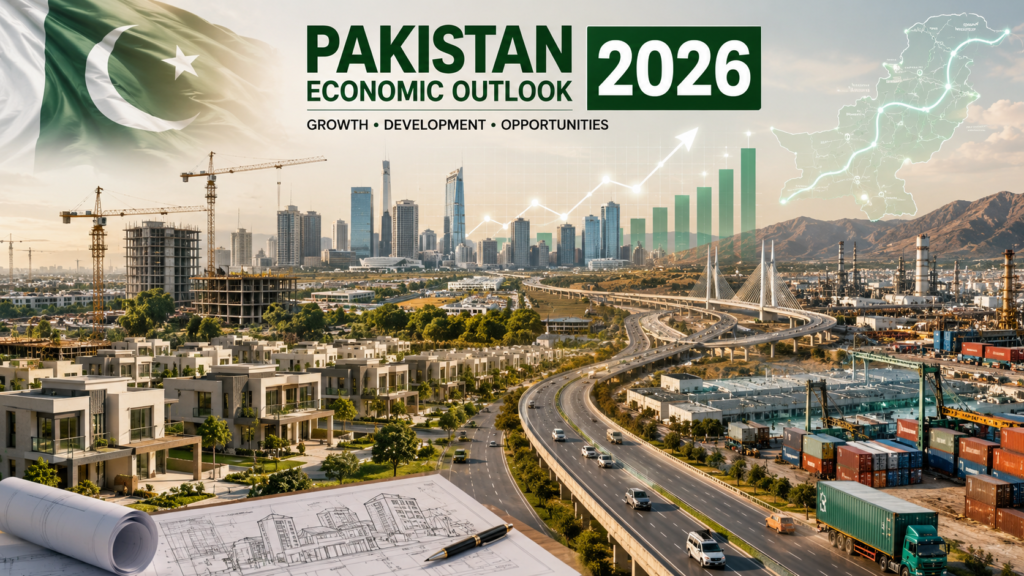
Pakistan Economic Outlook 2026: Growth, Infrastructure Investment and Development Opportunities

Pakistan 2026: Stabilization, Development Spending, and CPEC 2.0

Key Takeaways

Quick Facts Table

IndicatorReported Value / Focus
Provisional GDP Growth (FY 2026)3.70%
Services Sector Contribution4.09%
Industry Sector Contribution3.51%
Agriculture Sector Contribution2.89%
Development Budget Allocation (FY 2026‑27)Rs 3.6 trillion
Proposed Development ProgrammesOver Rs 4.4 trillion (subject to review)
Strategic InitiativeCPEC 2.0 — infrastructure and industrial cooperation

Introduction

This article summarises available, verified information on Pakistan’s economic and development landscape as reported for early 2026. The government and official publications indicate a phase of cautious stabilisation, underpinned by easing inflationary pressures, improving industrial activity, and stronger fiscal outcomes. Large development allocations and renewed emphasis on infrastructure—particularly under CPEC 2.0—feature prominently in recent federal planning. The purpose of this review is to synthesise the reported facts and draw out pragmatic implications for policy watchers, businesses, and property stakeholders.

Why It Matters

Macro stability and targeted public investment are foundational to medium‑term economic performance. The reported provisional GDP growth and sectoral contributions provide a snapshot of where activity is concentrated. Simultaneously, the large development budget and multi‑trillion‑rupee programme proposals indicate a pivot towards capital spending that could shape infrastructure, urban planning, and industrial capacity. For planners, investors, and local businesses, understanding these priorities helps align expectations, identify potential demand drivers, and highlight where verification and closer due diligence will be required.

Recent Developments

Investment Snapshot

Available information suggests a policy environment that is increasingly oriented toward infrastructure, transport links, and industrial support. Key themes that emerge from the reported developments are:

These priorities may generate business opportunities in construction, logistics, urban services, and sectors that support industrial clusters. However, exact project timelines, geographic distribution, and specific scheme details require further verification from official project documents and implementing agencies.

Market Analysis

The provisional sectoral performance indicates a services‑led recovery by reported figures, with industry and agriculture also contributing positively. Notable points include:

Comparison Table

AreaReported Emphasis / Outcome
Macro StabilityEasing inflation and improved fiscal balances reported
Services SectorLargest contributor to growth (4.09% provisional)
Industry SectorRecovery signalled (3.51% provisional)
Agriculture SectorPositive contribution (2.89% provisional)
Public InvestmentRs 3.6 trillion allocated for development; proposals over Rs 4.4 trillion under review
CPEC 2.0Ongoing focus on connectivity and industrial cooperation

Investment Score

The Investment Score is qualitative. Based on reported stabilisation trends, sectoral performance, and heightened development spending, the environment may be described as cautiously improving. Public‑sector emphasis on transport, urban infrastructure, and industrial cooperation suggests selective opportunities, subject to verification of project details and implementation schedules.

Investment Insight

For investors and businesses considering exposure to Pakistan’s development agenda, a few pragmatic considerations arise from the verified information:

Buyer Checklist

Pros and Cons

Market Outlook

According to available updates, Pakistan’s near‑term market outlook is shaped by cautious stabilisation and an active public investment programme. If implementation follows through, transport and urban infrastructure spending alongside industrial cooperation could support broader economic activity. Nonetheless, outcomes will depend on detailed project rollouts, financing, and institutional capacity. Continued monitoring of official sources and on‑ground developments will be important for market participants.

FAQ

Q: What is the headline GDP number for FY 2026?

A: The provisional GDP growth reported for FY 2026 is 3.70%.

Q: Which sectors contributed most to the reported growth?

A: Reported provisional contributions are services at 4.09%, industry at 3.51%, and agriculture at 2.89%.

Q: How large is the development budget for 2026‑27?

A: The federal budget reported an allocation of Rs 3.6 trillion for development projects in FY 2026‑27, with proposed programmes exceeding Rs 4.4 trillion under review.

Q: What role does CPEC play in the 2026 outlook?

A: CPEC 2.0 is described as a continuing strategic driver, with emphasis on infrastructure connectivity and industrial cooperation in recent planning documents.

Q: Are detailed project timelines and locations available?

A: The research summary notes that specific project timelines and geographic distribution require further verification from implementing agencies and official project documents.

Sources and Recent Developments Referenced

The analysis above is based on verified summaries drawn from official government publications and public policy documents, including:

Disclaimer

This article is for general information and market awareness only. It should not be treated as legal, financial, tax, or investment advice. Property prices, approvals, possession status, development progress, society policies, and market conditions may change over time. Readers should verify all information from official society sources, government authorities, legal advisors, and on-ground inspection before making any property decision. Zamai Property Partners does not accept liability for decisions made solely on the basis of this article.

Bottom Line

Early 2026 reporting indicates a cautiously stabilising Pakistani economy supported by easing inflation, improving industrial activity, and stronger fiscal outcomes. The federal government’s notable shift toward development spending—highlighted by a Rs 3.6 trillion allocation and multi‑trillion‑rupee programme proposals—places infrastructure, transport, and industrial cooperation (including CPEC 2.0) at the centre of the policy agenda. These developments suggest selective opportunities for businesses and investors that align with public spending priorities, though detailed project verification and careful due diligence are essential.

Conclusion

Pakistan’s 2026 economic narrative, as reflected in official summaries, is one of cautious recovery and reorientation toward public investment in infrastructure and industrial capacity. Market participants should interpret the available data as a directional signal rather than definitive project‑level guidance. Close monitoring of implementing agencies, budget execution reports, and on‑ground project updates will be necessary to translate these macro‑level priorities into actionable opportunities.

Zamai Property Partners Insight

Zamai Property Partners views the reported stabilisation and development focus as important context for stakeholders assessing opportunities in construction, logistics, and urban services. We recommend that clients and partners prioritise verification of project details, engage with local advisors, and maintain a medium‑term perspective when evaluating exposure to public infrastructure programmes and CPEC 2.0 initiatives.

World’s Most Expensive Houses of 2026 — Overview, Video Tours and Briefs

Collage of the world's most expensive houses in 2026 featuring a royal palace, luxury skyscraper mansion, French Riviera estate, oceanfront mega mansion, private helicopters, luxury cars, and premium real estate architecture.

Key Takeaways

This article presents a sourced, neutral summary of several of the most expensive private residences worldwide in 2026. Headline valuations place Buckingham Palace at the top, followed by Antilia in Mumbai. Iconic historic estates such as Villa Leopolda and Villa Les Cedres remain prominent among elite properties. The Ellison Estate is highlighted as a major U.S. example. Recent trends across these residences emphasize sophisticated automation, privacy, wellness features, and indoor-outdoor living design.

Quick Facts Table

PropertyLocationValuation (as reported)Noted Features
Buckingham PalaceLondon, United KingdomValued around $4.9 billionHistoric palace, symbol of national heritage
AntiliaMumbai, IndiaValued near $2 billion27-story private mansion; extensive amenities
Villa LeopoldaFrench RivieraValuation not specified in sourceVast terraced gardens; royal historic legacy
Villa Les CedresFrench Riviera (historic)Valuation not specified in sourceBuilt 1830; 14 bedrooms, library, ballroom
Ellison EstateCalifornia, USAValued around $200 millionAdvanced amenities; tech billionaire residence

Introduction

This article synthesizes verified points from compiled research notes on the highest-valued private residences in 2026. It focuses on headline-listed properties and broad trends reported across luxury real estate sources. Where specific figures or detailed interior descriptions were not available in the supplied notes, those points are omitted or identified as not specified. A recommended video tour is included for immersive visual reference.

Why It Matters

Ultra-high-value homes often function as cultural touchstones: they reflect architectural ambition, historical significance, or the concentration of private wealth. For readers interested in luxury real estate trends, these properties illustrate how design, privacy, and technology are prioritized at the highest tier. They also set informal benchmarks for craftsmanship, conservation of historic estates, and the integration of wellness and automation in private residences.

Recent Developments

Investment Snapshot

The headline valuations and descriptions supplied indicate a market segment characterized by scarcity, prestige and non-standard use cases. Properties like Buckingham Palace and Antilia are cited as high-value benchmarks. Historic estates such as Villa Leopolda and Villa Les Cedres are noted for their enduring appeal, while modern billionaire-owned estates exemplify advanced amenities and technology integration.

Market Analysis

Available notes suggest the high-end market for palaces, historic villas and billionaire estates remains varied across geography and typology. Coastal estates on the French Riviera continue to be associated with historic prestige and formal gardens. Urban ultra-luxury properties can emphasize vertical scale and extensive in-house services. A defining characteristic across these examples is the blending of hospitality-level service capabilities with private residential design, which shapes buyer expectations in this tier.

Comparison Table

PropertyPrimary AppealDesign & Amenities Highlights
Buckingham PalaceHistoric and symbolic national residencePalatial scale and heritage architecture
AntiliaVertical private mansion in an urban setting27 stories; extensive private amenities and staff facilities
Villa LeopoldaCoastal historic estate with gardensMassive terraced gardens; royal legacy from King Leopold II
Villa Les CedresHistoric grand residenceBuilt 1830; 14 bedrooms; grand library and ballroom
Ellison EstateTech billionaire estate with modern amenitiesAdvanced amenities reflecting high-tech owner preferences

Investment Score

The following qualitative score reflects characteristics observed in the research notes rather than market valuations or forecasts:

PropertyQualitative Investment Character
Buckingham PalacePrestige benchmark — symbolic, unique, and non-standard as a private market asset
AntiliaUltra-luxury private residence — showcases urban verticality and service capability
Villa LeopoldaHistoric coastal estate — legacy and landscape-driven value
Villa Les CedresHistoric grand residence — architectural significance and scale
Ellison EstateModern tech-owner residence — emphasis on amenities and systems

Investment Insight

Properties at this tier often function as cultural or symbolic assets as much as real estate holdings. The research notes suggest buyers and observers evaluate such houses on criteria beyond simple market comparables: historical significance, security and privacy arrangements, service infrastructure, and the level of bespoke architectural and technological integration.

Buyer Checklist

Pros and Cons

Market Outlook

Notes indicate continuing interest in both historic estates and technologically advanced private residences. Preference drivers include privacy, wellness, sustainability, and immersive indoor-outdoor environments. Because the supplied material does not include forward-looking market data or price forecasts, readers should treat the above as a snapshot of current features and valuations rather than a prediction of future performance.

FAQ

Q: Which property was listed as the most expensive in 2026?

A: The research notes report Buckingham Palace as the most expensive residence in 2026, valued around $4.9 billion.

Q: Is Antilia the second most expensive house?

A: The notes indicate Antilia in Mumbai is ranked second, with a valuation near $2 billion.

Q: Are full price breakdowns and sale availability provided?

A: No. The supplied notes state that detailed price breakdowns and current market availability beyond headline figures were not specified and may require verification.

Q: Where can I see video tours of these homes?

A: The research summary recommends a YouTube video titled “Inside the World’s Most Expensive Homes 2026: A Day in Their Luxurious Lives” for visual tours and context. Viewers should verify specifics from original sources linked within such videos.

Sources and Recent Developments Referenced

This article is based solely on the supplied research summary and referenced materials within that summary. Source types listed in those notes include a NoBroker blog article, a YouTube video tour (Cozillerior Design channel), a LuxHabitat article, a Facebook video listing reference, and assorted real estate news and luxury market insight websites. Recent development themes referenced include increased smart automation, sustainability focus, and expanded indoor-outdoor living design in elite properties.

Disclaimer

This article is for general information and market awareness only. It should not be treated as legal, financial, tax, or investment advice. Property prices, approvals, possession status, development progress, society policies, and market conditions may change over time. Readers should verify all information from official society sources, government authorities, legal advisors, and on-ground inspection before making any property decision. Zamai Property Partners does not accept liability for decisions made solely on the basis of this article.

Bottom Line

Headline valuations and descriptions place Buckingham Palace and Antilia at the top of 2026 lists for the world’s most expensive private residences, with historic French Riviera estates and major billionaire-owned properties also prominent. These homes collectively illustrate how historical legacy, bespoke amenities, privacy and advanced home technology define the uppermost tier of private residential real estate.

Conclusion

This compilation aims to provide a concise, cautious overview of the world’s most expensive houses as reflected in the supplied research notes for 2026. It highlights headline valuations, characteristic amenities, and recent trends across the ultra-luxury segment while noting areas where additional verification is recommended.

Zamai Property Partners Insight

For readers exploring ultra-luxury properties or research in this market segment, Zamai Property Partners recommends prioritizing on-ground verification, specialist legal due diligence, and technical assessment of automation and service infrastructures. Visual tours such as the recommended video can provide useful orientation, but confirmed documentation and expert advice remain essential before any decision-making.

Best Housing Societies in Multan for Investment in 2026

Key Takeaways

Multan’s residential market shows renewed investor interest in 2026, supported by infrastructure improvements and development along the CPEC Western Route. A group of societies stands out in available updates: DHA Multan, Royal Orchard, Buch Villas, Citi Housing Multan Phase 1, Wapda Town Phase 1, Dream Gardens Phase 2, Pearl City (PC Colony), Hateem City, Faisal Cottages, and Cantt Avenue Society near Askari Bypass. Each offers different degrees of maturity, approvals, and lifestyle positioning. Verification on-ground is advised for phases and projects where detailed data is limited.

Quick Facts Table

SocietyApproval / StatusDevelopment StatusNotable Feature
DHA MultanFully developed, possession-readyComplete infrastructureFlagship project; high security and signal-free corridor
Royal Orchard MultanMDA-approvedActive developmentProximity to South Punjab Secretariat developments
Buch VillasNOC-approvedPhased construction ongoingLuxury villas; shorter investment horizons
Citi Housing Multan Phase 1EstablishedFully mature phase with expansionLocated on Bosan Road; mix of residential and commercial options
Wapda Town Phase 1MDA-approvedWell establishedNear Northern Bypass; various plot sizes
Dream Gardens Phase 2MDA-approvedActive phase-wise developmentGated community features; developer backing
Pearl City (PC Colony)DevelopingProgressing with amenitiesAmenity-rich positioning
Hateem CityDeveloping premium mixed-useOngoing facility roll-outNear PC Hotel; family-oriented design
Faisal CottagesDevelopingAdvancing near Askari BypassLuxury residential focus
Cantt Avenue Society (near Askari Bypass)EmergingPromoted for prime plotsOpposite Dream Garden area; balanced urban setting

Introduction

This article presents a measured overview of leading housing societies in Multan for 2026 investment consideration. The content is derived from compiled, verified updates and recent development notes. It aims to provide an analytical snapshot covering approvals, development maturity, infrastructure links, and relative positioning in the local market. Prospective buyers and investors should treat this as a starting point for due diligence rather than a definitive investment directive.

Why It Matters

Multan’s strategic location along the CPEC Western Route and recent infrastructure activity are contributing to renewed attention from buyers and investors. For individuals evaluating residential opportunities, understanding society approvals, possession readiness, developer reputation, and connectivity is important. Societies with mature infrastructure and credible approvals typically require less short-term verification, while newer or phase-wise projects often require more detailed on-ground checks.

Recent Developments

Recent society-level updates indicate varying stages of readiness across the city. DHA Multan is noted as a possession-ready, fully developed society with extensive infrastructure and a signal-free corridor. Royal Orchard is continuing infrastructure work and benefits from nearby governmental developments. Buch Villas reports phased construction with active deliveries. Citi Housing Phase 1 is expanding into new blocks and commercial zones. Dream Gardens Phase 2 continues phase-wise evolution with gated-community amenities. Hateem City has reported successful balloting events and is progressing facility roll-out. Additionally, DHA has installment schemes reported with four-year plans and initial booking amounts mentioned in recent updates.

Investment Snapshot

Across the societies reviewed, there are a few recurring themes for 2026:

Market Analysis

Available updates point to a market environment in Multan that is responding to broader transport and institutional developments. The CPEC Western Route is cited as a strategic factor affecting regional interest. Local market dynamics appear to favor projects with clear approvals and visible infrastructure progress. Societies with possession-ready plots and established road links—such as DHA Multan and Wapda Town Phase 1—are noted as preferred by some local and overseas buyers. Mid-term investment interest is also recorded for MDA-approved projects like Royal Orchard and Buch Villas. For parts of the city where on-ground verification is lacking (for example Wapda Town Phase 2 & 3 and Dream Gardens Phase 1 block-level updates), further inspection is recommended before commitments.

Comparison Table

CriterionDHA MultanRoyal OrchardBuch VillasCiti Housing Phase 1Wapda Town Phase 1Dream Gardens Phase 2
ApprovalFully developed / possession-readyMDA-approvedNOC-approvedEstablishedMDA-approvedMDA-approved
Infrastructure MaturityHighMedium-HighMediumHigh (mature phase)HighDeveloping (gated-community features)
Target BuyerSecurity- and possession-focused buyersMid-term investorsBuyers seeking luxury villasMixed investor and end-user baseLocal investors and residentsBuyers seeking gated-community lifestyle
AccessibilitySignal-free corridor and regional linksClose to government developmentsResidential pocketsBosan Road connectivityNear Northern BypassPlanned internal connectivity

Investment Score

The following qualitative summary reflects relative characteristics based on verified updates and recent developments. These are not financial recommendations but descriptive categories to help focus due diligence.

Investment Insight

For 2026, a practical approach is to align purchase objectives with society characteristics. If possession readiness and established infrastructure are primary concerns, societies noted as fully developed or mature merit closer review. For buyers focused on gated-community amenities or villa-style living, projects like Dream Gardens Phase 2, Buch Villas, and Hateem City may match preferences but should be assessed for phase-specific delivery schedules. Emerging plots near Askari Bypass could offer location convenience, but their long-term status should be confirmed through on-ground checks and legal verification.

Buyer Checklist

Pros and Cons

Market Outlook

Available information suggests a cautiously optimistic market environment for Multan in 2026, anchored by infrastructure initiatives and select mature societies that continue to attract buyers. The city presents a range of options from possession-ready flagship developments to lifestyle-oriented gated communities. Given the mixture of mature and developing projects, prospective buyers should focus on documented approvals and visible infrastructure progress as primary selection criteria.

FAQ

Q: Which societies in Multan are possession-ready?
A: DHA Multan is noted as fully developed and possession-ready in available updates. Some plots in mature phases of other societies may be ready, but verification is advised.

Q: Are government approvals available for these societies?
A: Several societies referenced are reported as MDA-approved or NOC-approved (for example Royal Orchard, Wapda Town Phase 1, Dream Gardens Phase 2, Buch Villas). Buyers should request and verify official documents from society or municipal offices.

Q: Is the CPEC Western Route influencing Multan’s real estate?
A: Summarized updates indicate CPEC-related infrastructure developments are a contributing factor to renewed market interest in the region.

Q: Should I consider newer phases or stick to established societies?
A: That depends on your risk appetite and timeline. Mature, possession-ready societies typically reduce short-term delivery risk. Newer phases may offer different amenities but require closer due diligence on delivery schedules and approvals.

Q: Where can I confirm the latest plot availability and payment plans?
A: Contact society offices directly and request official payment plan documents. Recent reports mention four-year installment structures for DHA with lower initial booking amounts, but these should be validated with society representatives.

Sources and Recent Developments Referenced

This article is based on compiled research summaries referencing official society portals, real estate marketing outlets, local news items, social media updates from society and broker accounts, and property listing platforms. Recent development notes cited include possession readiness for DHA Multan, installment plan mentions, phase-wise progress reports for Dream Gardens Phase 2 and Buch Villas, and balloting events and facility updates for Hateem City.

Disclaimer

This article is for general information and market awareness only. It should not be treated as legal, financial, tax, or investment advice. Property prices, approvals, possession status, development progress, society policies, and market conditions may change over time. Readers should verify all information from official society sources, government authorities, legal advisors, and on-ground inspection before making any property decision. Zamai Property Partners does not accept liability for decisions made solely on the basis of this article.

Bottom Line

Multan’s housing market in 2026 presents a mix of established, possession-ready societies and developing gated-community projects. DHA Multan, Citi Housing Phase 1, and Wapda Town Phase 1 emerge as societies with mature infrastructure in available updates, while Royal Orchard, Buch Villas, Dream Gardens Phase 2, Hateem City, Pearl City, Faisal Cottages, and Cantt Avenue offer varying degrees of development and lifestyle propositions. Buyers should prioritize documented approvals, visible infrastructure, and on-ground verification when narrowing options.

Conclusion

Choosing the right society in Multan depends on buyer priorities—possession and infrastructure versus lifestyle amenities and phased project features. The societies profiled here provide a cross-section of the city’s 2026 residential landscape, each with distinct characteristics. A step-wise approach to verification and targeted site visits will help align purchase decisions with individual requirements.

Zamai Property Partners Insight

Zamai Property Partners recommends treating this overview as a curated starting point. For grounded decision-making, combine society-level document checks with on-ground inspections, developer performance reviews, and professional legal counsel. This approach helps balance short-term certainty with longer-term lifestyle and location considerations in Multan’s evolving market.

The Multan Dealer Boom: How the City Got 5,000 New Property Offices in Six Years — and What It Broke

By Zamai Property Partners · May 2026 · 6 min read

Between 2020 and 2026, something unusual happened in Multan’s real estate market. If you spent any time on Bosan Road, Northern Bypass, or around the expanding commercial strips near DHA Multan, you would have noticed it almost immediately. Property offices seemed to appear overnight. What was once a business dominated by a relatively small circle of established agencies suddenly became crowded with consultants, brokers, freelancers, social media agents, and self-styled real estate advisors. In just a few years, property dealing in Multan shifted from a specialised profession into something that almost anyone seemed willing to try.

A decade ago, the local property market felt much smaller and far more predictable. Buyers generally knew the names of serious agencies, and most transactions happened through offices with established reputations. Many firms had been operating for years, sometimes generations, and trust played a major role in how business was conducted. That landscape has changed dramatically. Today, a polished office is no longer the standard marker of credibility. Some dealers operate from commercial plazas, others from shared desks, and some have no physical office at all, relying entirely on WhatsApp, Facebook, or YouTube to attract clients.

The turning point was 2020. COVID disrupted traditional businesses and pushed many people to look for alternative income sources. At the same time, Pakistan’s construction sector incentives created renewed excitement around real estate investment. Multan happened to be well positioned for that wave. DHA Multan was beginning to show real development progress, the M-5 Motorway improved connectivity, overseas remittances remained strong, and multiple housing schemes were launching aggressively. For many people, real estate looked like the easiest opportunity available, and property dealing became the preferred entry point.

What followed was not gradual growth but a rapid explosion. People who had never worked in real estate began facilitating small deals, earning commissions, and deciding to stay in the business. Informal brokers emerged everywhere—friends connecting buyers to sellers, part-time consultants chasing leads, and newcomers trying to build credibility through social media. The barriers to entry were almost non-existent. A smartphone, confidence, and a few property videos were often enough to start appearing legitimate.

Social media accelerated the transformation. Before this period, property sales in Multan were largely relationship-based, with trust built through personal connections and local reputation. After 2020, visibility became the new currency. Younger dealers embraced YouTube walkthroughs, TikTok clips, drone footage, and Facebook marketing far faster than traditional firms. Suddenly, a person sitting in Multan could generate inquiries from Karachi, Lahore, Dubai, Toronto, or Birmingham without ever meeting a client face to face. In many cases, digital presence began to replace professional credentials in the minds of buyers.

To be fair, not all of this change was negative. The newer generation brought energy and modern marketing practices to a market that had often felt outdated. Presentation standards improved. Response times became faster. Multan’s property sector gained wider visibility, especially among overseas Pakistanis. But the same accessibility that encouraged innovation also lowered standards. When anyone can enter a profession overnight without training, licensing, or accountability, the quality of market participants inevitably becomes inconsistent.

By late 2021 and into 2022, the market felt unstoppable. Plot prices were rising, investors were flipping files quickly, and new housing projects kept entering the conversation. Confidence was high, perhaps unrealistically so. In such an environment, people stop asking whether prices are sustainable and start assuming growth will continue indefinitely. That mindset fed the dealer boom, because when everyone believes transactions will keep happening, everyone wants a share of the commissions.

The correction, when it came, was harsh. Rising interest rates, inflation, higher construction costs, tax pressures, and weakening speculative confidence slowed the market significantly. The easy-money phase ended, and the difference between genuine businesses and temporary operators became obvious. Established firms survived because they had systems, repeat clients, and reputations to protect. Informal operators often vanished just as quickly as they had appeared. Buyers who had trusted branding or aggressive sales pitches discovered that some “agencies” were little more than short-term setups.

Perhaps the biggest damage was not purely financial, but reputational. Trust in the profession took a major hit. When buyers repeatedly encounter exaggerated claims, manipulated pricing, unclear approvals, or disappearing agents, they become sceptical of everyoneincluding honest professionals. That trust deficit still affects the market today. Serious agencies continue to operate responsibly, but suspicion has become a natural starting point for many buyers.

The rapid expansion of loosely regulated selling also created opportunities for poor-quality or questionable projects to gain traction. Buyers often assumed that if multiple dealers were promoting a scheme, it must be credible. That assumption proved costly in many cases. Approval status, possession claims, and development timelines became areas where buyers needed far more caution than many initially realised.

By 2026, the market feels more grounded. It is no longer driven by the same speculative enthusiasm, but it is not collapsing either. Real development activity in stronger projects has helped restore some confidence. DHA Multan’s possession sectors show actual residential construction, educational institutions are contributing to end-user demand, and investors appear more selective than they were during the peak years. That is a healthier environment overall.

Still, the dealer overhang remains. Many individuals who entered the market during the boom are still active, competing for fewer transactions in a more cautious environment. That pressure can encourage shortcuts, aggressive selling, or misleading positioning. Buyers today need to be far more deliberate than those who entered during the hype cycle.

The Multan dealer boom left behind a mixed legacy. It modernised marketing, created employment, expanded visibility, and brought fresh energy into the city’s real estate sector. But it also increased noise, weakened trust, and made it harder for ordinary buyers to distinguish between professionals and opportunists. Both realities exist at the same time.

The most practical lesson for buyers remains simple: verify the person, not just the project. A professional-looking social media page is not proof of credibility. Ask questions, visit offices, cross-check approvals, compare rates, and be cautious of urgency-driven sales tactics. In today’s market, patience is often more valuable than speed.

At Zamai Property Partners, we believe real estate should be transparent, documented, and professionally handled. Whether you are buying, selling, or simply trying to understand where the market stands, informed decisions matter more than ever.